
Written by the CA & GST Adjudication Team, Rudra Capital — with direct experience drafting GST Show Cause Notice replies, representing taxpayers at show cause hearings, and filing first appeals before Appellate Authorities across Delhi NCR. Over 200 SCN matters handled successfully.
Last reviewed: June 2026 | References: Sections 73, 74, 75, 76 CGST Act 2017 · Rule 142 CGST Rules · CBIC Instructions 01/2023 · GST DRC-01, DRC-01A, DRC-01C forms · Madras HC: M/s. Safari Retreats Pvt Ltd · Delhi HC: M/s. Bhagat Ram Om Parkash
 Covers: SCN vs DRC-01 distinction · Section 73 vs Section 74 analysis · Critical 30-day deadline · Consequences of ignoring · 5-point SCN reading checklist · Document gathering · Reply drafting structure · Personal hearing strategy · First appeal process
If you have received a GST Show Cause Notice, your response window is limited and the consequences of the wrong move are severe.
An SCN is not a final demand — it is a legal notice inviting you to explain why a tax demand should not be confirmed. If you respond correctly and on time, most SCNs can be resolved without a confirmed demand, without interest, and without penalties. If you ignore it, or respond incorrectly, the demand is confirmed and becomes a legally enforceable liability — recoverable from your bank account, receivables, and assets.
Every year, thousands of GST taxpayers across India receive Show Cause Notices from the department. Many pay demands they could have successfully contested. Others ignore notices and find their accounts attached six months later. A small number engage experienced GST professionals, respond strategically, and close the matter without paying a rupee more than they legitimately owed.
This guide tells you which outcome is achievable in your situation — and exactly what to do to achieve it.
What Is a GST Show Cause Notice — and How Is It Different from a DRC-01?
Not every GST notice is an SCN. Understanding the difference prevents unnecessary alarm — and prevents under-reaction to the ones that truly matter.
Form DRC-01 — Summary Show Cause Notice (automated)
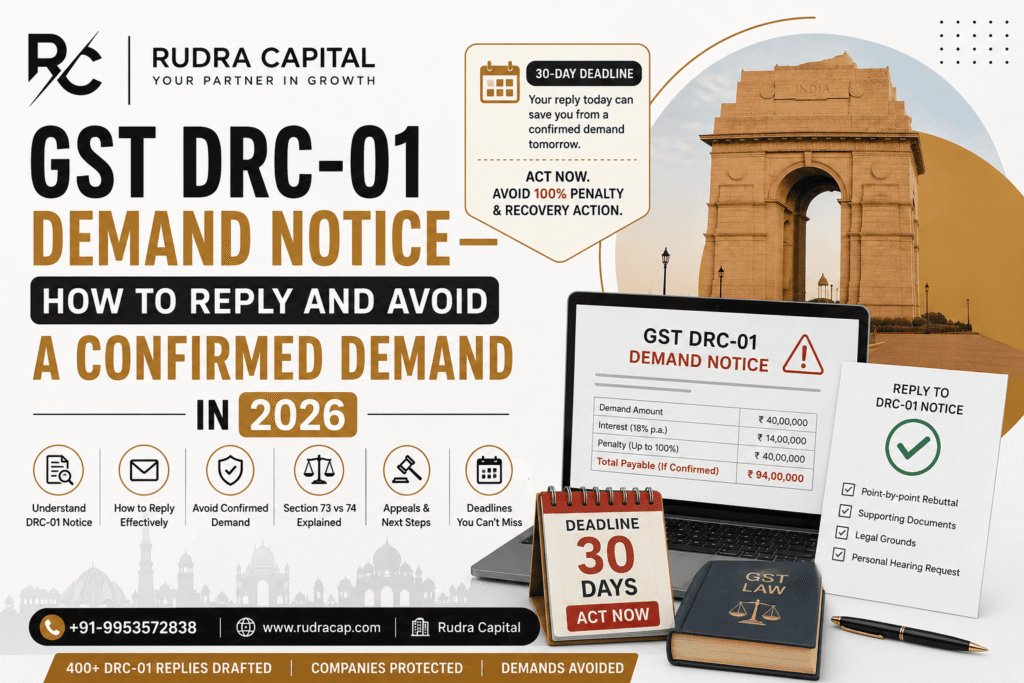
Issued automatically by the GSTN system when its reconciliation engine detects a discrepancy — typically ITC mismatch, turnover mismatch, or GSTR-3B vs GSTR-1 difference. DRC-01 is a pre-adjudication communication. It is serious and must be responded to, but it is not yet a formal adjudication order.
Response window: As stated in the notice (often 7–30 days). Respond through the portal’s “Additional Notices and Orders” section.
Form DRC-01A — Pre-notice Communication for ITC Mismatch
Issued under Rule 88C specifically when GSTR-3B ITC exceeds GSTR-2B by more than the permissible limit. You must respond within 7 days with either a payment of the excess amount or an explanation. If you do not respond, a formal SCN (DRC-01) follows automatically.
Response window: 7 days from issue — the shortest window in GST compliance. Do not miss this.
Formal Show Cause Notice — Section 73 or 74 (what this guide covers)
Issued by a Proper Officer under Section 73 or Section 74 of the CGST Act. Specifies the tax demand, the legal grounds, and the tax period involved. Initiates the formal adjudication process. This is a quasi-judicial proceeding — the officer’s order is appealable up to the Supreme Court.
Response window: 30 days from receipt (extendable at officer’s discretion). A written reply + personal hearing opportunity. Carries real legal consequences if ignored.
Section 73 vs Section 74 — The Single Most Important Distinction in Your SCN
The first thing you must identify in any GST Show Cause Notice is which section it is issued under. This one fact determines your entire response strategy, your penalty exposure, and whether an early settlement is financially rational.
| Parameter | Section 73 — Genuine Error | Section 74 — Fraud / Suppression |
|---|---|---|
| Applies when | Tax shortfall due to genuine error, oversight, or incorrect interpretation — no fraud or deliberate misstatement | Tax shortfall due to fraud, suppression of facts, wilful misstatement, or deliberate evasion |
| Time limit for SCN | Within 3 years from the relevant due date | Within 5 years from the relevant due date |
| Maximum penalty (if confirmed) | 10% of tax (minimum ₹10,000) | 100% of tax evaded — demand doubles |
| Pay before SCN issued | Zero penalty | 15% penalty |
| Pay within 30 days of SCN | 25% reduced penalty | 25% reduced penalty |
| Pay within 30 days of adjudication order | 50% reduced penalty | 50% reduced penalty |
 The department sometimes issues Section 74 notices where the facts only support Section 73 — and this is one of the most powerful grounds for defence. Section 74 requires the department to demonstrate fraud or wilful suppression — not merely that tax was underpaid. If your SCN cites Section 74 but the underlying facts involve an ITC mismatch, a timing difference, or a classification dispute (all of which are genuine errors, not fraud), challenging the applicability of Section 74 in your reply is both legally sound and potentially very valuable — reducing maximum penalty from 100% to 10% of tax.
Critical Deadlines You Cannot Miss After Receiving an SCN
| Action | Deadline | Consequence of missing |
|---|---|---|
| File written reply to SCN | 30 days from receipt | Officer proceeds ex-parte — demand confirmed without hearing you |
| Pay tax + 25% penalty (Section 73 early settlement) | Within 30 days of SCN | Reduced penalty benefit lost; penalty increases to 50% at adjudication stage |
| Respond to DRC-01C ITC mismatch pre-notice | 7 days from issue | Formal SCN automatically issued; ITC blocked |
| Appeal against adjudication order to Appellate Authority | 3 months from order | Appeal right lost; demand becomes final and recoverable |
| Pay tax + 50% penalty (Section 73, after adjudication order) | Within 30 days of order | Full penalty applies; matter proceeds to recovery |
✓ On extensions: The 30-day reply window can be extended by the adjudicating officer on request. Write a brief request citing need for additional time to compile documentary evidence. Do not assume an extension will be granted automatically — prepare your reply regardless, and if the extension is granted, use the extra time to strengthen it further. A partially prepared reply is better than a missed deadline.
What Happens If You Ignore a GST Show Cause Notice
This section is written for the business owners who think ignoring a GST notice will make it go away. It will not. Here is precisely what happens, in chronological order:
Day 30 — No Reply Filed
The 30-day reply window closes. The adjudicating officer notes the non-response. Under Section 73(8) or 74(9), the officer is legally empowered to proceed ex-parte — issuing a demand order without your input.
Day 31–90 — Ex-Parte Adjudication Order
The officer issues a demand order confirming the tax, interest at 18–24% per annum from the original due date, and the full penalty (10% under Section 73 or 100% under Section 74). This is a quasi-judicial order with full legal force.
Recovery Proceedings Begin
Under Section 79, the department can: (a) deduct from pending GST refunds; (b) issue recovery notices to your customers/debtors directing them to pay your receivables to the government instead; (c) attach and sell movable and immovable property; (d) request banks to freeze and release funds from your accounts.
Bank Account Provisional Attachment
Under Section 83, during or after adjudication, the Commissioner can provisionally attach your bank accounts for up to one year if there is a risk that recovery will be defeated. Account freezes can halt business operations entirely — this happens faster than most business owners anticipate.
Criminal Prosecution (Large Section 74 Cases)
For confirmed demands involving fraud above ₹500 lakh under Section 74, criminal prosecution under Section 132 of the CGST Act is possible — with imprisonment from 1 to 5 years. The prosecution threshold was reduced in 2024.
How to Read Your SCN — 5 Things to Check Before Writing a Single Word
When you receive an SCN, the volume of legal language can be overwhelming. Focus on these five things in this order before doing anything else:
Check 1 — Which section is cited: 73 or 74?
As explained above, this single fact determines your penalty exposure and your entire defence strategy. If the SCN cites Section 74 but the facts look more like genuine error, your reply must challenge this characterisation as a primary defence.
Check 2 — Is the demand within the limitation period?
Section 73 SCNs must be issued within 3 years of the relevant due date. Section 74 SCNs must be issued within 5 years. Calculate from the due date for the earliest period under demand. If the SCN was issued beyond the limitation, raise limitation as a threshold preliminary objection — a time-barred SCN is void regardless of the merits of the demand.
Check 3 — Are the grounds stated with sufficient specificity?
A valid SCN must identify the specific transactions, specific amounts, and specific legal grounds for the demand. An SCN that says merely “ITC improperly claimed” without identifying which invoices, which suppliers, and what the specific deficiency is lacks sufficient particulars. You can request specific particulars before responding to the merits — this is a legally available option that can buy time and sometimes reveals weaknesses in the department’s case.
Check 4 — What is your exact response deadline?
Calculate 30 days from the date of receipt — not from the date of issue. Note the exact calendar date and set a reminder for 25 days from receipt (leaving 5 days for review and filing). If the notice was sent by post, check the envelope for the delivery date — this is your day zero, not the date on the notice.
Check 5 — Is early settlement financially rational?
For Section 73 notices where the underlying tax liability is genuinely correct: paying within 30 days with a 25% reduced penalty may be the most cost-effective outcome. Calculate: tax + interest + 25% penalty vs tax + interest + 10% penalty (if you contest and win) vs full penalty (if you contest and lose). Sometimes settling is cheaper than contesting even when you have strong defences.
Gathering the Right Documents Before Drafting Your Reply
A strong SCN reply is evidence-driven. Before writing the reply itself, assemble all documentary evidence organised by the specific ground in the notice:
| SCN Ground | DOCUMENTS TO GATHER?? |
|---|---|
| ITC mismatch / excess ITC claimed | GSTR-2B downloads for relevant months; purchase invoices for every challenged ITC line; bank payment proof to suppliers; e-way bills; delivery challans; supplier’s GSTR-1 filings (from GSTR-2A) |
| Outward supply turnover mismatch | GSTR-1 filed for each relevant period; actual sales invoices; order documentation; credit notes with reasons; explanation of any advance receipts vs actual supply date differences |
| RCM non-compliance | List of all unregistered vendor payments; invoices from each; self-invoices raised (if available); GSTR-3B showing RCM liability paid (if any was paid) |
| Section 74 fraud allegation | Bank statements showing actual payments to/receipts from the disputed parties; financial statements showing transactions in books; all correspondence with supplier/customer; physical evidence of goods receipt or service delivery (inspection certificates, GRNs) |
| Classification / rate dispute | Technical specifications or composition data of goods; CBIC classification circulars or rulings supporting your rate; any advance ruling obtained; industry-standard classification evidence |
How to Draft a Legally Sound GST SCN Reply — Structure and Language
A well-drafted SCN reply is structured, evidence-referenced, legally grounded, and directly addresses every ground in the notice — nothing more, nothing less. Here is the standard structure used by experienced GST professionals:
Standard SCN Reply Structure
1
Opening paragraph — identification and reservation
Cite the SCN by date, reference number, and issuing officer. State you are filing the reply “without prejudice to your rights and contentions.” Assert that the demand is not sustainable. This formal language protects you from any implied admission.
2
Preliminary objections (if any)
Before addressing merits: (a) limitation — if the SCN is time-barred; (b) jurisdiction — if the officer lacks jurisdiction; (c) section — if Section 74 is incorrectly applied to what is a Section 73 situation; (d) insufficient particulars — if the SCN is too vague to respond to meaningfully. Raise all available preliminary objections. They are not waivable by omission once the reply is filed.
3
On merits — paragraph-by-paragraph response
Address each ground in the SCN separately. For each ground: (1) state what the SCN alleges; (2) state your position; (3) cite the legal provision, rule, or CBIC circular supporting your position; (4) reference the attached documentary evidence (by exhibit number). Never make a factual assertion in the reply that is not supported by an attached document.
4
Closing paragraph and prayer
Request that the SCN be dropped without confirming any demand. Formally request a personal hearing to make oral submissions. Reserve the right to file additional submissions. Sign with authorised signatory’s details and company seal.
5
Exhibit list
Number every attached document. Every document referenced in the body of the reply must appear in the exhibit list with a description. Missing exhibits are as harmful as missing arguments — the adjudicating officer will disregard unexhibited claims.
Section 73 SCN Strategy — Using the Early Payment Benefit Intelligently
Section 73 contains a unique provision that allows you to effectively close the matter with zero or minimal penalty — but only if you act within specific windows. Here is the optimal decision framework:
Best case — pay before SCN
Zero penalty
If you discover the liability before receiving the SCN, pay tax + interest immediately. No penalty attaches under Section 73(5). SCN proceedings close automatically.
Good case — pay within 30 days of SCN
25% penalty
Pay tax + interest + 25% of the demanded penalty within 30 days of receiving the SCN. Adjudication proceedings close. This is often the most commercially rational outcome for undisputed liabilities.
Contest and lose
100% penalty
If you contest, go to hearing, and the officer confirms the demand: full 10% penalty (max) confirmed. Then pay within 30 days of the order for 50% reduction, or the full amount if you appeal and lose at appellate stage.
✓ The rational framework: For Section 73 SCNs, always calculate: (a) tax + interest + 25% penalty (settle within 30 days) vs (b) cost of contesting (professional fees, time, risk of losing). If (a) is less than or comparable to (b), settling is rational. The decision to contest should be driven by: genuine legal uncertainty about whether the liability exists at all, or the precedent-setting importance of the issue for future transactions — not by optimism that the officer will accept a weak defence.
Section 74 SCN Strategy — Challenging the Fraud Allegation
A Section 74 SCN is a fundamentally different challenge because it makes a serious legal allegation — fraud or deliberate suppression. This allegation cannot be conceded. Even if you eventually pay the tax, allowing a Section 74 characterisation to stand creates risks for future proceedings.
Defence 1 — Challenge the Section 74 characterisation directly
The SCN must identify the specific acts of fraud or suppression with particularity. General allegations like “the taxpayer suppressed turnover” are not sufficient to invoke Section 74. In your preliminary objections, state that the facts as alleged constitute a genuine error (Section 73 situation), not fraud, and challenge the department’s burden of proof under Section 74.
Defence 2 — Establish the bona fide nature of every transaction
Every invoice, ITC claim, or supply value challenged in the SCN must be backed by evidence of a genuine commercial transaction: bank statements showing actual payment, delivery records, goods receipt notes, signed service completion certificates. Genuine transactions cannot be fraud — the evidence speaks for itself.
Defence 3 — Show consistent disclosure
“Suppression” implies active concealment. If the disputed transactions appeared in your GSTR-1, in your books of accounts, and in your ITR — they were not suppressed. They were visible. The courts have consistently held that what is disclosed in returns cannot simultaneously be characterised as suppressed. Use your filed returns as evidence of disclosure.
Defence 4 — Cite relevant judicial precedents
Courts across India have set high standards for invoking Section 74. Cite relevant High Court and Supreme Court decisions holding that: (a) ITC mismatches due to supplier non-filing do not constitute fraud; (b) incorrect rate classification without concealment is Section 73, not Section 74; (c) timing differences in turnover reporting are not suppression. A well-cited reply signals to the adjudicating officer that the matter has been researched thoroughly.
What Happens at the Personal Hearing — and How to Use It
Under Section 75(4) of the CGST Act, the adjudicating officer must give you an opportunity of being heard before confirming any demand. Always request a personal hearing in your written reply — even if your reply is comprehensive, a hearing allows you to:
- Address the officer’s specific concerns interactively — something a written reply alone cannot do
- Gauge the officer’s receptiveness and adjust your settlement position in real time
- Present physical documents and walk the officer through reconciliation calculations in person
- Request additional time to file supplementary submissions if the officer raises new points
Key hearing etiquette: Appear personally or through an authorised representative (CA, advocate, or GST practitioner). Bring physical copies of every exhibit. Do not argue legal provisions you are uncertain about — incorrect citations damage credibility more than staying silent. If the officer raises entirely new grounds not in the original SCN, note them and state on record that you require an opportunity to respond to the new grounds in writing — an adjudication order on grounds not in the SCN is a procedural defect that can be challenged on appeal.
Appealing Against an Unfavourable Adjudication Order
If the officer confirms the demand despite your reply, the appellate process provides multiple levels of review:
| Forum | Time limit | Pre-deposit | Form |
|---|---|---|---|
| Appellate Authority (Joint/Additional Commissioner, Appeals) | 3 months from order | 10% of disputed tax | APL-01 on GST portal |
| GST Appellate Tribunal (GSTAT) | 3 months from AA order | 20% of disputed tax | APL-05 |
| High Court (substantial question of law) | 180 days from GSTAT order | Court’s discretion | Writ petition under Article 226 |
✓ Pre-deposit strategy: The pre-deposit (10% at first appeal level) is paid against the disputed tax — not the penalty. If a ₹50 lakh demand comprises ₹40 lakh tax + ₹10 lakh penalty, the pre-deposit is ₹4 lakh (10% of ₹40 lakh). The penalty portion is stayed by the mere filing of the appeal. For demands where the penalty is a large component of the total, filing an appeal is often financially attractive even with the pre-deposit requirement.
Received a GST Show Cause Notice? The response window is short — act now.
Rudra Capital’s CA team has handled over 200 GST SCN matters — Section 73 settlements, Section 74 defences, show cause hearings, and Appellate Authority appeals. We provide initial assessment within 24 hours and complete reply drafting within 10 days.
Our process: SCN analysis → strategy recommendation → document gathering → reply drafting → hearing representation → post-order follow-up.

FAQs — GST Show Cause Notice India 2026
Related reading: GST Registration Cancelled — How to Reinstate · GST Pain Points 2026 · GST Return Filing Mistakes · GST Return Filing Services