✍️
Written by the GST Compliance Team, Rudra Capital — GST advisors who have resolved 200+ registration suspension and cancellation matters for Indian companies, managing both REG-18 replies to show cause notices and system-driven suspensions arising from return and reconciliation discrepancies.
Last reviewed: July 2026 | References: CGST Act 2017 (Section 29) · CGST Rules 2017 (Rule 21, 21A, 22) · CBIC Circular 145/01/2021-GST on system-based suspension · CBIC Standard Operating Procedure on Registration Suspension 2024 · Finance Act 2025
Registration Suspension
Emergency Response
🗓 July 2026 · 15-min read
 For business owners and finance teams who have logged into the GST portal and found their registration status showing “Suspended.” Covers: the two distinct triggers for suspension · why suspension is not the same as cancellation · what it means for invoicing and e-way bills right now · the fastest legal paths to reactivation · a real cost scenario · How Rudra Capital helps · 9 expert FAQs
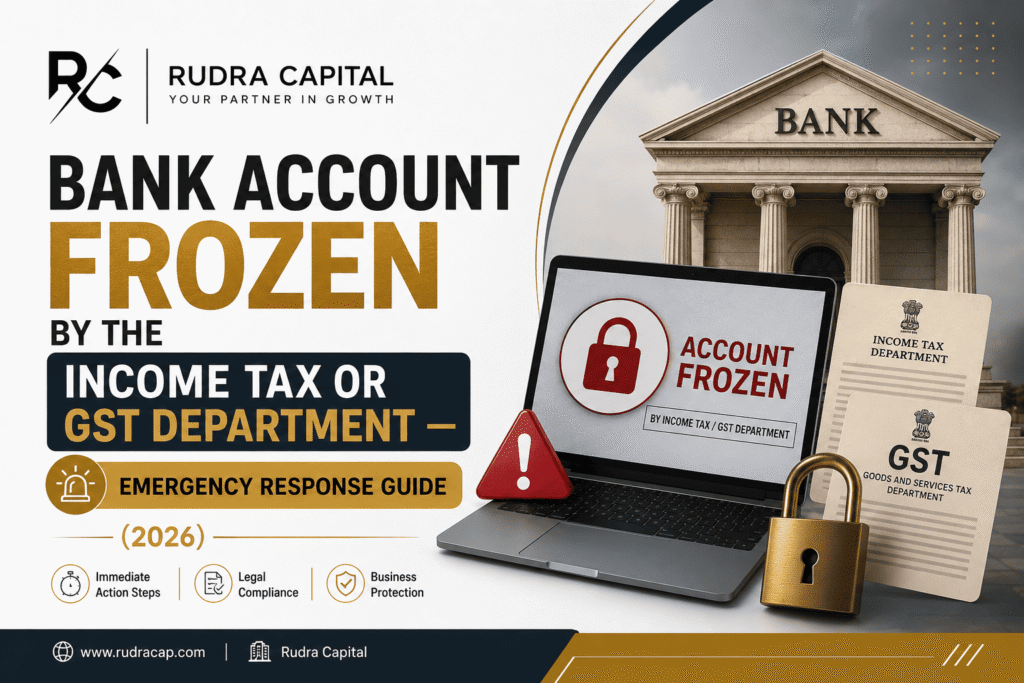
A GST registration suspension is one of the most operationally disruptive events a business can experience — and one of the least understood. Unlike a tax demand or a scrutiny notice, which unfolds over weeks, suspension takes effect immediately, often without the business realising it until an invoice fails to generate, an e-way bill request is rejected, or a customer’s finance team flags that your GSTIN is showing an inactive status on the portal. For a mid-size distribution or manufacturing business moving goods daily, this can mean an effective halt to normal operations within hours of the suspension taking effect.
This guide explains exactly what triggers a Rule 21A suspension, why it is legally and practically different from a cancellation, and the fastest path back to an active status.
The most important thing to understand first: Suspension is not cancellation. Your GST registration still legally exists — it has simply been placed on hold pending either your explanation or the department’s final decision. In the large majority of cases Rudra Capital has handled, a suspension is fully reversible within days to a few weeks, provided the correct procedural response is filed promptly.
The Two Ways a GST Registration Gets Suspended
Trigger 1 — Suspension pending a cancellation Show Cause Notice (Rule 21A(2)): Where the proper officer issues a Show Cause Notice proposing to cancel your registration — for reasons ranging from non-filing of returns to a suspected registration irregularity — your registration is automatically suspended from the date the SCN is issued, even before you have had a chance to respond. This is designed to prevent further transactions on a registration that may ultimately be cancelled, but it means the suspension often arrives as a surprise, bundled with the SCN itself.
Trigger 2 — System-driven suspension for return and reconciliation anomalies (Rule 21A(2A)): Since 2021, GSTN’s backend system automatically flags and suspends registrations where it detects significant differences between GSTR-1 and GSTR-3B, or between GSTR-3B and the auto-populated GSTR-2B, that exceed specified thresholds — without any human officer reviewing the case first. This is now one of the most common causes of suspension for otherwise compliant mid-size businesses, because the system does not distinguish between deliberate irregularity and a genuine timing or reconciliation error.
| Status | What It Means | Can You Invoice? | Reversible? |
|---|---|---|---|
| Suspended | Registration on hold, pending explanation or final order | No | Yes, quickly |
| Cancelled | Registration formally terminated by final order | No | Only via revocation application within statutory window |
Has your GST portal suddenly shown your registration as “Suspended” — and you’re not sure whether this followed a Show Cause Notice or was triggered automatically by the system without any officer review? The correct response depends entirely on which trigger applies. Responding to a system-driven suspension the same way you would respond to an SCN-based suspension (or vice versa) wastes time you don’t have while your invoicing remains blocked.
Let our GST Compliance team identify exactly which trigger applies to your suspension and start the correct reactivation process today. Click here for an immediate suspension review or call us directly at +91-9953572838
What Suspension Actually Means for Your Business, Starting Today
- You cannot issue a valid tax invoice for outward supplies during the suspension period — most billing software and e-invoicing systems will reject invoice generation once the GSTIN status changes
- You cannot generate e-way bills for movement of goods, effectively halting dispatch of any consignment above the threshold value
- Your customers’ finance and procurement teams will typically see the inactive status when verifying your GSTIN, which can trigger payment holds or a demand for clarification before they continue transacting with you
- You are not required to file GSTR-1 or GSTR-3B for the suspension period itself, though this varies by the specific circumstances and should be confirmed for your case — do not assume filing obligations have paused without professional confirmation
- Any refund application pending at the time of suspension is typically put on hold until the suspension is resolved
The Fastest Path Back to Active Status — By Trigger Type
①
For SCN-based suspension: file a comprehensive reply in Form REG-18
Within the timeline specified in the SCN (typically 7 working days), a detailed reply addressing every ground raised must be filed through Form REG-18, supported by documentary evidence. Where the reply satisfies the officer, the SCN is dropped and the suspension is revoked. A weak or generic reply, mirroring the pattern seen with other GST notices, frequently results in the SCN being confirmed and the registration formally cancelled — a materially harder position to recover from.
②
For system-driven suspension: file pending returns and/or a reconciliation explanation
Where suspension is triggered automatically due to a GSTR-1/3B or 3B/2B variance, the standard remedy is to file any overdue returns and submit a reply on the portal explaining the specific variance — supported by a line-item reconciliation. Where the variance arises from a legitimate and explicable cause (timing differences, credit notes, vendor amendment lag), a well-documented explanation typically results in reactivation without further escalation.
③
Request a personal hearing where the online reply alone does not resolve it
Where the initial written reply does not immediately result in reactivation, requesting a personal hearing with the jurisdictional officer allows your representative to directly address any residual concerns — often resolving matters that would otherwise sit unattended in the portal queue for weeks.
A Real Example: Twelve Days of Lost Billing From a Preventable Reconciliation Gap
Consider a representative scenario reflecting a pattern Rudra Capital has resolved multiple times. A Faridabad-based auto components distributor found its GSTIN suspended overnight due to a system-flagged variance between GSTR-3B and GSTR-2B exceeding the department’s threshold — caused by a large vendor filing several months of GSTR-1 late, creating a temporary mismatch that had nothing to do with any wrongdoing by the distributor itself. The company’s internal accounts team, unfamiliar with the Rule 21A(2A) mechanism, spent the first several days trying to call the local GST helpline rather than filing a formal, documented explanation.
By the time a proper reconciliation statement and explanation were filed on day nine, the company had already lost twelve days of billing capacity — unable to invoice approximately ₹1.6 crore in scheduled deliveries, several of which were rescheduled to a competitor by an impatient customer. Reactivation was granted within 4 business days of the properly documented explanation being filed. The underlying cause — a vendor’s late filing, entirely outside the company’s control — was resolved almost immediately once addressed correctly; the real cost was the delay in identifying the correct procedural response.
Is your registration suspended due to a GSTR-3B vs GSTR-2B mismatch caused by a vendor’s late filing or an amendment lag — a variance that has nothing to do with any wrongdoing on your part? These system-driven suspensions are frequently resolved quickly once a proper line-item reconciliation is filed — but the portal will not resolve it automatically, and every day it remains unaddressed is a day of blocked invoicing and e-way bills.
Let our GST Reconciliation team build your variance explanation and file it today. Click here to get your reactivation started or call us directly at +91-9953572838
If Suspension Escalates to Cancellation
If the underlying SCN is confirmed and the registration is formally cancelled, the remedy shifts to filing a revocation application under Section 30 of the CGST Act, typically within 90 days of the cancellation order (extendable in specified circumstances), supported by full compliance with any conditions the officer prescribes — such as filing all overdue returns and clearing any outstanding tax, interest, and late fees. Revocation applications filed with a complete compliance package and a clear explanation of the original grounds have a materially higher success rate than incomplete or delayed applications.
Has your suspended registration already escalated into a formal cancellation order? The 90-day window to file a revocation application is strict, and a successful application requires clearing every overdue return and outstanding liability the officer specifies — not just filing a request. A partial or incomplete revocation application is frequently rejected, forcing you to start the process again.
Let our GST Compliance team build your complete revocation package and manage the entire process to reinstatement. Click here for an urgent revocation consultation or call us directly at +91-9953572838
How Rudra Capital Helps — GST Suspension and Reactivation
Rudra Capital’s GST Compliance team handles suspension and cancellation matters with the urgency they require — because every day of suspension is a day of blocked billing.
Same-Day Trigger Diagnosis
Immediate identification of whether your suspension is SCN-based or system-driven, and the correct response for each.
REG-18 Reply Drafting
Fast-turnaround, documented replies to cancellation Show Cause Notices designed to secure suspension revocation.
Reconciliation Explanations
Line-item GSTR-1/3B/2B variance reconciliation for system-driven suspensions, filed with supporting documentation.
Revocation Applications
Complete revocation packages for confirmed cancellations, including overdue return clearance and liability settlement coordination.
Every day your GST registration stays suspended is a day of blocked invoices, blocked e-way bills, and unhappy customers. Most suspensions are resolved within days once the correct reply is filed — but only if you file the right one.
Rudra Capital has resolved 200+ GST suspension and cancellation matters. Call now for a same-day review of your suspension.

Has your suspension already been active for more than a week without resolution — and your internal team’s attempts to resolve it through the helpline or portal have not produced a response? A suspension left unaddressed for too long increases the risk of the underlying SCN being confirmed by default, converting a reversible suspension into a formal cancellation that requires a materially harder revocation process.
Let our GST Compliance team take over your suspension matter today and escalate it through the correct formal channel. Click here for immediate escalation support or call us directly at +91-9953572838
FAQs — GST Registration Suspension Under Rule 21A (2026)
Related reading: GST DRC-01 Demand Notice — How to Reply · E-Way Bill Risk Management Framework 2026 · GST Compliance Advisory — Contact Rudra Capital