
Written by the CA & GST Advisory Team, Rudra Capital — handling GST notice responses, pre-emptive reconciliation, and compliance strategy for mid-market companies, e-commerce brands, and manufacturing businesses across Delhi NCR. We respond to 50+ GST notices annually and have seen every category described in this guide.
Last reviewed: June 2026 | References: GSTN Analytics Directorate Report 2025 · CBIC Automated Scrutiny Data 2024-25 · Finance Ministry GST Compliance Statistics · DRC-01C Rule 88C CGST Rules · Section 61 CGST Act · CBDT-GSTN MoU 2023
 For finance directors, CFOs, and tax managers at mid-to-large Indian companies. Covers: 10 notice triggers · ITC mismatch · GSTR-1 vs GSTR-3B · GST-ITR turnover gaps · RCM non-compliance · MSME payment rules · E-Way Bill violations · GSTR-9 discrepancies · supplier network risk · prevention playbook · How Rudra Capital helps · 9 expert FAQs
In FY 2024-25, the GST department issued over 33,000 automated compliance notices — a number that represents a 340% increase from FY 2022-23. The majority of these notices were not the result of human investigators identifying suspicious taxpayers. They were generated automatically by GSTN’s AI reconciliation engine, which runs continuously on every taxpayer’s data and triggers notices when predefined anomaly thresholds are breached.
This means that in 2026, receiving a GST notice is not a sign that your business has done something seriously wrong or that the tax department has specifically targeted you. It can mean simply that one or more data points in your GST filings crossed a statistical threshold that the system is programmed to query. The notice arrives regardless of your intent, regardless of whether you have a competent CA, and regardless of your overall compliance quality — unless you have specifically structured your compliance processes to prevent the conditions that trigger it.
This guide identifies the ten specific conditions that trigger the most GST notices for Indian mid-market businesses in 2026, explains exactly why each one triggers a notice, and gives you the precise prevention strategy for each — so that your business stays below the threshold that attracts automated enforcement action.
The critical insight: Most GST notices in 2026 are preventable. They arise not from fraud or deliberate non-compliance but from gaps between what a business’s financial systems track and what GSTN’s AI cross-checks. Bridging that gap — with the right reconciliation processes, compliance documentation, and proactive CA oversight — eliminates the conditions that generate notices before they are issued.
Notice Reason 1 — ITC Claimed Exceeds GSTR-2B (DRC-01C)
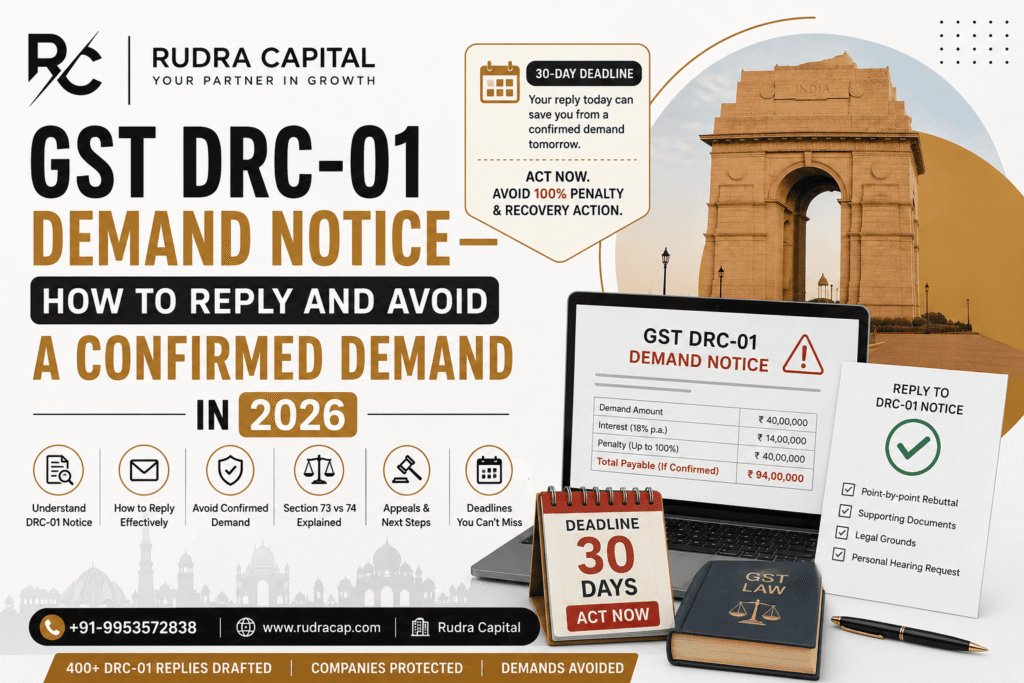
The trigger: Under Rule 88C, when the ITC claimed in GSTR-3B for any tax head (IGST, CGST, SGST) exceeds the ITC available in GSTR-2B by more than 5% or Rs 25 lakh, the GSTN system automatically generates Form DRC-01C — a pre-notice communication requiring the taxpayer to either pay the excess or explain it within 7 days.
Why it happens: Suppliers file their GSTR-1 late. The buyer claims ITC in the month the invoice was received but the supplier’s GSTR-1 only appears in the next month’s GSTR-2B. The buyer has claimed more ITC than GSTR-2B shows for that period — generating the DRC-01C automatically, even though the ITC is perfectly legitimate.
The 2026 escalation: Under the Zero Mismatch policy effective April 2026, the portal now blocks GSTR-3B filing if ITC exceeds GSTR-2B beyond the tolerance threshold. The DRC-01C is no longer just a post-filing notice — it is a pre-filing blocker.
Prevention strategy: Download GSTR-2B on the 14th of each month. Reconcile your purchase register against GSTR-2B before filing GSTR-3B. Claim only ITC that appears in GSTR-2B. Maintain a monthly supplier compliance tracker — follow up with late-filing suppliers immediately when their invoices do not appear in GSTR-2B. Build supplier filing consistency into your vendor selection and retention criteria.
Notice Reason 2 — GSTR-1 Outward Supply Differs from GSTR-3B
The trigger: The GSTN’s Invoice Matching Engine compares the total outward supply declared in GSTR-1 with the taxable turnover declared in GSTR-3B for every taxpayer, every month. A material discrepancy — typically above Rs 10 lakh or 5% of total turnover — generates a DRC-01A notice automatically.
Why it happens: GSTR-1 and GSTR-3B are often prepared by different people at different times from different reports. Amendments made to GSTR-1 after GSTR-3B is filed create gaps. Credit notes issued in one period affect GSTR-1 but are sometimes not reflected in the same period’s GSTR-3B liability. The two returns become inconsistent not through dishonesty but through process disconnection.
Prevention strategy: Before filing GSTR-3B, run a mandatory comparison: total taxable supply per GSTR-1 vs taxable turnover per GSTR-3B by tax rate (5%, 12%, 18%, 28%). Document every variance with the specific cause — credit notes, advances, timing differences. File GSTR-3B only when the variance is either zero or explained and documented. Make this a non-skippable step in your monthly compliance checklist.

Receiving DRC-01A or DRC-01C notices? Our CA team builds reconciliation frameworks that prevent these notices — call us for an immediate assessment · +91-9953572838
Notice Reason 3 — GST Turnover Materially Different from Income Tax Return Revenue
The trigger: Under the CBDT-GSTN data sharing MoU (2023), the GST system automatically compares every company’s GSTR-9 aggregate turnover with the revenue declared in ITR-6. Variances above the tolerance band — approximately 15-20% for most industry categories — generate automated Section 61 CGST Act scrutiny notices.
Why it happens legitimately: There are many valid reasons for GST-ITR turnover differences. GST turnover includes taxable and exempt supplies; ITR revenue may exclude some GST-exempt income. Advances received generate GST liability when received but revenue recognition in accounts follows delivery. Export supplies are included in GST turnover but recognised differently in accounts. Credit notes timing differs between GST and accounting treatment.
Why it becomes a notice problem: The legitimate differences are real — but they are invisible to the GSTN’s automated comparison. Without a documented reconciliation statement that categorises and explains each variance, the system treats the gap as anomalous. The Section 61 notice asks for an explanation that should have been prepared in advance.
Prevention strategy: Prepare a GST-to-ITR revenue reconciliation statement every year before filing both GSTR-9 and ITR-6. Categorise every rupee of difference: exempt income, advance timing, export LUT supplies, credit note adjustments, non-GST income. Keep this document permanently accessible. When the Section 61 notice arrives — and for businesses above Rs 10 crore it is increasingly when, not if — the response is a copy-and-send exercise rather than a 48-hour crisis requiring document reconstruction.
Notice Reason 4 — Reverse Charge Mechanism Non-Compliance
The trigger: Businesses that pay for legal services (from individual advocates), goods transport agency services, import of services, director fees to non-executive directors, and a range of other notified categories are required to pay GST under Reverse Charge Mechanism. Non-payment is identified through cross-referencing: TDS records show payments to advocates and GTA operators; the GST system checks whether the payee reported RCM. Non-disclosure triggers ASMT-10 scrutiny notices.
The foreign services RCM gap: The most commonly missed and most financially significant RCM obligation for mid-market businesses in 2026 is RCM on foreign SaaS, cloud, and digital service payments. Every payment to AWS, Google Cloud, Microsoft Azure, Shopify, Salesforce, HubSpot, and similar foreign platforms is an “import of services” attracting 18% GST under RCM. Many finance teams process these as foreign currency expenses without GST treatment, accumulating liability that grows with every monthly subscription payment.
 The compounding exposure: A business spending Rs 15 lakh per month on foreign SaaS that does not declare RCM for 24 months has accumulated Rs 64.8 lakh in undeclared RCM liability (18% of Rs 3.6 crore). At discovery, this becomes Rs 64.8 lakh in back-tax plus 18% annual interest (Rs 14 lakh) plus potential penalty of up to 100% (Rs 64.8 lakh) — total exposure approaching Rs 1.44 crore for a compliance gap that would have cost Rs 0 in net cash if handled correctly from day one (since RCM paid is simultaneously claimable as ITC for eligible businesses).
Prevention strategy: Build a foreign vendor register listing every foreign service provider, the monthly payment amount, and the applicable RCM rate. Compute RCM on the 20th of each month for all eligible payments in the prior month, declare in GSTR-3B, pay through the Cash Ledger, and claim back as ITC in the same return. Net cash impact is zero for eligible businesses. Compliance gap: eliminated.
Notice Reason 5 — E-Way Bill Non-Compliance and Interception
The trigger: Section 68 and Rule 138B give GST enforcement officers the right to intercept and inspect any vehicle transporting goods. Non-compliance with E-Way Bill requirements — missing EWB, expired EWB, vehicle number mismatch, or goods description mismatch — generates on-the-spot detention notices in Forms MOV-02 and MOV-09, with penalties of 100% of the applicable tax or Rs 10,000, whichever is higher.
The AI risk profiling dimension: From 2025, GSTN’s AI system assigns risk scores to E-Way Bills at generation based on: supplier compliance history, buyer risk score, HSN risk category, and consignment value relative to typical transaction size. High-risk EWBs are flagged for priority interception at the next checkpoint. A business with a high overall GSTIN risk score will see its E-Way Bills disproportionately intercepted — making compliance quality upstream directly affect road transportation risk downstream.
The most common EWB notice triggers:
- EWB generated after goods have already left the premises
- EWB expires during long-distance transit without extension
- Vehicle breakdown requiring transfer to another vehicle without updating Part B
- Stock transfers between warehouses without delivery challan and EWB
- Distance underreported in Part B causing premature expiry
Prevention strategy: Build EWB generation into the dispatch process — no goods leave the warehouse until the driver has the EBN number confirmed. For long-distance shipments, monitor validity expiry and request extension within the 8-hour window. Configure automated alerts for EWBs approaching expiry for shipments in transit. Update vehicle number immediately if goods are transferred due to breakdown.

E-Way Bill compliance issues or goods detained? Require expert GST enforcement response — call our CA team immediately · +91-9953572838
Notice Reason 6 — GSTR-9 Annual Return Discrepancies
The trigger: The GSTN runs a comprehensive validation on every GSTR-9 at filing — comparing the annual totals against the sum of 12 months of GSTR-1 and GSTR-3B filings. Material discrepancies between GSTR-9 and the cumulative monthly returns generate DRC-01A notices post-filing. The most common discrepancy types: Table 6 ITC in GSTR-9 differs from the sum of 12 GSTR-3B ITC rows; turnover in GSTR-9 differs from the 12-month GSTR-1 total.
The December pressure problem: E-commerce brands and multi-GSTIN businesses face a specific GSTR-9 risk: the December 31 deadline coincides with peak operational season. Finance teams file GSTR-9 under time pressure without completing the reconciliation work that would catch discrepancies before they become notice triggers. Starting GSTR-9 preparation in August — not December — is the systemic solution.
Prevention strategy: Begin GSTR-9 preparation in August each year. Run the four-part reconciliation: (1) GSTR-1 vs GSTR-3B outward supply for each month; (2) GSTR-2B vs claimed ITC for each month; (3) GST turnover vs books of accounts; (4) GST turnover vs ITR-6 revenue. Resolve every variance before populating the GSTR-9 form. The form is the last step, not the starting point.
Notice Reason 7 — Non-Filing or Late Filing of GST Returns
The trigger: Non-filing of GSTR-1 for 2 consecutive months (or quarters for QRMP filers) or GSTR-3B for 6 consecutive months triggers an automated STK-5 equivalent process — the GST portal system generates notices escalating to GSTIN suspension or cancellation. Even periodic late filing keeps the GSTIN in an elevated risk category that attracts more frequent automated scrutiny.
The penalty escalation that most businesses underestimate:
- Late GSTR-3B: Rs 50/day (Rs 20/day for nil returns), capped at Rs 10,000 per return
- Late GSTR-1: Rs 50/day (Rs 20/day for nil), capped at Rs 10,000 per return
- Interest on unpaid tax: 18% per annum from the due date — no cap, compounds monthly
- GSTN blocks GSTR-3B filing if GSTR-1 for that period is pending — creating a compliance cascade
Prevention strategy: Build a compliance calendar with hard deadlines — GSTR-1 by the 9th (not the 11th deadline), GSTR-3B by the 18th (not the 20th). Assign a specific person responsibility for each filing. Check the portal every Monday for any notices or issues. A missed nil return that costs Rs 50/day in late fees is entirely preventable with a 5-minute monthly filing discipline.
Notice Reason 8 — Supplier Compliance Network Risk (Fraudulent ITC)
The trigger: GSTN’s AI analyses not just a taxpayer’s own compliance but their supplier network. If a significant portion of your ITC comes from suppliers with poor compliance scores — suppliers who file GSTR-1 regularly but do not pay GST in GSTR-3B, or suppliers who have cancelled GSTINs, or suppliers who appear in known fake invoice networks — your GSTIN is flagged for departmental review even if your own filings are perfectly clean.
The innocent buyer problem: GST law requires that an ITC claim is valid only if the supplier actually paid the tax. A buyer who received genuine goods, paid the supplier, and claimed ITC based on a tax invoice is legally entitled to the ITC. But if the supplier fraudulently collected GST without remitting it, the ITC claim becomes the subject of a Section 73/74 demand — potentially with fraud allegations attaching to the buyer even though the buyer was the victim.
The evolving judicial position: Courts have been increasingly protective of good-faith buyers in the past two years, requiring the department to demonstrate that the buyer knew or ought to have known about the supplier’s fraud. Maintaining documentation of due diligence — GSTN verification of supplier GSTIN at onboarding, periodic compliance status checks, bank payment evidence — is now essential for ITC defence even for entirely legitimate transactions.
Prevention strategy: Verify every new supplier’s GSTIN on the GSTN portal before onboarding. Re-verify all significant supplier GSTINs quarterly. Monitor GSTR-2B to ensure suppliers are actually filing — a supplier whose invoices suddenly stop appearing in GSTR-2B is a red flag. Maintain a vendor compliance scorecard. For high-value suppliers, consider ITC indemnification clauses in purchase agreements.
Notice Reason 9 — Incorrect HSN Codes and Rate Application
The trigger: GSTN cross-checks HSN codes declared in GSTR-1 against the goods description and the tax rate applied. Mismatched or inconsistent HSN codes — different codes for the same product across different returns, or HSN codes that do not match the applicable tax rate — generate classification scrutiny notices. Additionally, e-invoice IRP rejection for incorrect HSN creates an immediate operational problem as invoices fail validation.
The 6-digit requirement trap: From FY 2023-24, businesses with turnover above Rs 5 crore must use 6-digit HSN codes. Many businesses upgraded their accounting software but did not systematically update their product master from 4-digit to 6-digit codes. The result: e-invoices rejected at IRP, buyers unable to claim ITC, and GSTR-1 HSN summary not matching the 6-digit requirement.
Prevention strategy: Conduct an annual HSN audit — verify every product and service in your catalogue against the current CBIC tariff and notification list. Update the HSN master in your ERP. Verify that the HSN code maps to the correct GST rate. For businesses above Rs 5 crore, confirm all HSN codes are 6-digit. Run a test e-invoice before activating any new product code to confirm IRP acceptance.
Notice Reason 10 — Section 43B(h) MSME Payment Disallowance and Tax Scrutiny
The trigger: Section 43B(h) of the Income Tax Act (not GST directly, but triggered by the same GST-ITR cross-matching infrastructure) disallows the income tax deduction on payments to Micro and Small enterprise suppliers made beyond 45 days. Tax auditors are now required to report Section 43B(h) disallowance in Form 3CD, and the income tax department’s automated scrutiny systems flag ITRs where declared Section 43B(h) disallowance appears inconsistent with the scale of MSME-registered vendor payments visible from GSTN data.
The cross-system enforcement: The government’s data sharing infrastructure means MSME payment non-compliance detected through GST and TDS data can trigger income tax scrutiny. A business with Rs 2 crore of MSME vendor payments outstanding for more than 45 days at year-end has both a GST notice risk (through indirect cross-matching) and an income tax scrutiny risk (through Form 3CD qualification and ITR anomaly detection).
Prevention strategy: Tag every MSME vendor in your ERP with their UDYAM status. Monitor MSME vendor invoice outstanding dates weekly. Run a pre-March year-end sweep (third week of March) — pay all MSME invoices outstanding for more than 40 days before March 31 to restore the income tax deduction for the year. File Form MSME-1 half-yearly to document compliance.

Are any of these 10 notice triggers present in your business right now? Our CA team conducts GST compliance health checks — call us for a free initial assessment · +91-9953572838
The GST Notice Prevention Playbook — Monthly and Annual Disciplines
Monthly (before GSTR-3B filing)
- Download GSTR-2B on the 14th; reconcile against purchase register
- Compare GSTR-1 outward supply total vs GSTR-3B taxable turnover
- Compute and declare RCM on foreign services and other notified categories
- Check GST portal notices section for any new DRC or ASMT notices
- Verify MSME vendor outstanding invoices approaching 45-day threshold
Annually (before GSTR-9 filing)
- Prepare GST-to-ITR revenue reconciliation statement
- Run full-year ITC recovery audit — claimed vs entitled
- Verify all supplier GSTINs are active and non-cancelled
- Annual HSN code review against current CBIC tariff
- Pre-GSTR-9 reconciliation — 12-month GSTR-1 vs GSTR-3B vs books
How Rudra Capital Helps — GST Notice Prevention and Response
At Rudra Capital, our CA team works with mid-market companies to prevent GST notices through proactive compliance management and to respond effectively when notices do arrive. Our services directly address every notice trigger identified in this guide:
Monthly GST Compliance
GSTR-2B reconciliation, GSTR-1 vs GSTR-3B cross-check, RCM computation and declaration, MSME payment monitoring — all completed before filing, not after receiving notices.
GST Notice Response
Expert response to DRC-01A, DRC-01C, Section 61 scrutiny, ASMT-10, and Section 73/74 SCNs — with strategic assessment of whether to contest or settle and legal drafting of responses.
GSTR-9 Management
Annual return preparation starting August with full reconciliation — eliminating the December-pressure GSTR-9 errors that generate post-filing DRC notices.
GST-ITR Reconciliation
Annual documented reconciliation of GST turnover vs ITR revenue — ensuring that when Section 61 notices arrive, the response is immediate and complete.
GST notices are preventable. The right compliance system stops them before they start.
Rudra Capital’s CA team builds and manages the monthly compliance processes that keep businesses below the GSTN anomaly detection thresholds — and responds expertly when notices do arrive. Serving mid-market companies across Delhi NCR.

FAQs — GST Notices India 2026
Related reading: GST Show Cause Notice Reply Guide · GSTR-9 Annual Return Guide · AI – GST Compliance · GST Return Filing Services