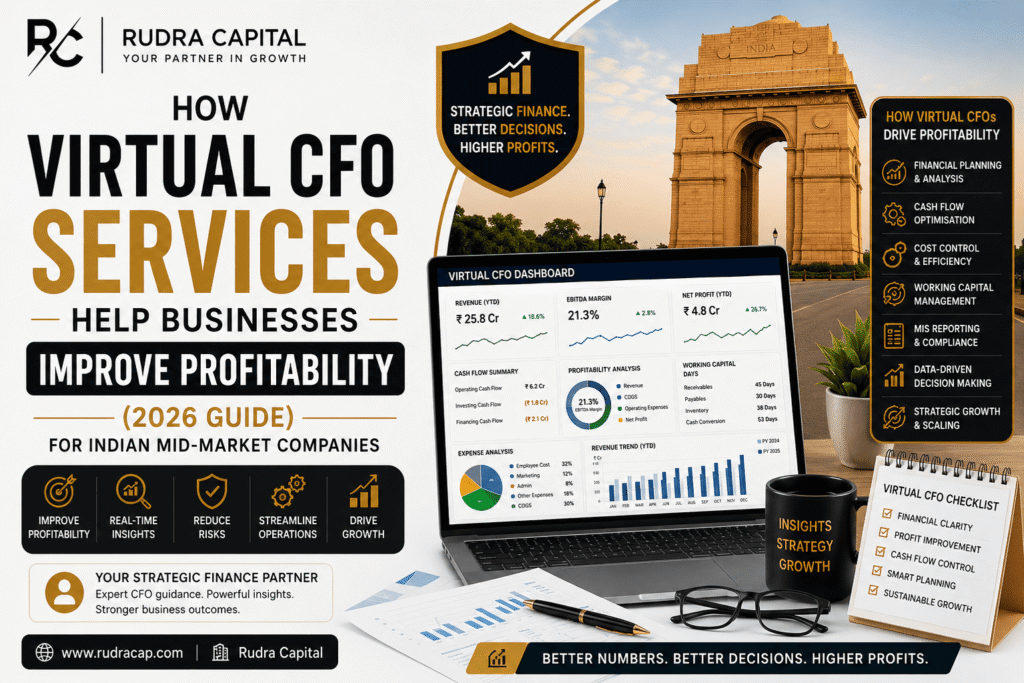

Written by the CA & CFO Advisory Team, Rudra Capital — providing Virtual CFO and strategic financial advisory services to mid-market companies, e-commerce brands, and professional services firms across Delhi NCR. We have served as Virtual CFO for 30+ businesses at revenue stages from Rs 8 crore to Rs 150 crore, and have helped founders understand when they need strategic finance leadership versus operational compliance support.
Last reviewed: June 2026 | References: ICAI CFO Services Framework 2025 · Deloitte India CFO Survey 2025 · KPMG India Virtual CFO Market Report 2024 · Companies Act 2013 (Section 203 KMP provisions) · Finance Ministry MSME Financial Services Accessibility Report 2025
 For founders, MDs, and business owners at Indian mid-market companies. Covers: what a Traditional CA delivers · what a Virtual CFO delivers · the 6 critical differences · when your business needs each · cost comparison at every revenue stage · the danger of over-relying on a compliance CA for strategic decisions · the Virtual CFO engagement model explained · How Rudra Capital helps · 9 expert FAQs
Most Indian business owners know what a Chartered Accountant does. They file your taxes. They complete your GST returns. They sign your audit report. They tell you your tax liability at the end of the year. For a business at Rs 5 crore in revenue, this is sufficient. For a business at Rs 50 crore trying to raise its first institutional round, or at Rs 80 crore evaluating an acquisition, or at Rs 30 crore trying to understand why its cash position keeps deteriorating despite strong revenue growth — a compliance CA, however excellent, is not the right tool.
A Virtual CFO is something different — not a replacement for your CA, but a complement to it. Where a traditional CA looks backward (what happened, what do we owe, what do we need to file), a Virtual CFO looks forward (where is this business going financially, what decisions should the leadership be making, what does the next 24 months of cash flow look like, and how should we structure this expansion to minimise tax cost and maximise strategic flexibility?).
In 2026, the Virtual CFO model has become one of the fastest-growing advisory service categories for Indian mid-market businesses — because the complexity of operating a Rs 20–200 crore business has outgrown what a compliance-focused CA relationship alone can support, while a full-time in-house CFO is often too expensive and too difficult to recruit at this revenue stage.
This guide gives you the complete, precise picture of what each role delivers, where they overlap, where they do not, and how to make the right choice for your business’s current stage and future trajectory.
The one-sentence distinction: A Traditional CA ensures your business is compliant with what happened. A Virtual CFO ensures your business makes better decisions about what happens next. Both are necessary. They serve different functions, at different frequencies, with different outputs.
What a Traditional CA Delivers — The Compliance Foundation
A chartered accountant’s primary mandate is compliance — ensuring the business meets its statutory and regulatory obligations accurately and on time. The services a traditional CA engagement covers:
Tax Compliance
- Income tax return (ITR-6) preparation and filing
- Advance tax computation and payment scheduling
- Tax audit (Form 3CD) for eligible businesses
- TDS deduction, payment, and quarterly return filing
- Tax notice response and assessment representation
GST Compliance
- Monthly GSTR-1 and GSTR-3B preparation and filing
- Annual GSTR-9 and GSTR-9C preparation
- GST registration management (multi-state)
- ITC reconciliation and monitoring
- GST notice response and adjudication
Statutory Audit
- Statutory audit of financial statements
- Internal audit and systems review
- Balance sheet and P&L certification
- Auditor’s report and qualifications
- Bank audit for NBFCs and cooperatives
MCA / ROC Compliance
- AOC-4 financial statements filing
- MGT-7 annual return preparation and filing
- Director KYC (DIR-3) compliance
- DPT-3 and other event-based filings
- Company incorporation and corporate secretarial
The traditional CA’s orientation: Backward-looking and compliance-driven. The primary output is accurate historical records, filed returns, and clean audit reports. The primary value is avoiding penalties, maintaining good standing with regulatory authorities, and ensuring the business has accurate books. These are essential — but they are not sufficient for a business that needs to make complex financial decisions about its future.
The traditional CA’s gap: Most Indian CA firms at the small-to-mid tier are structured to handle volume compliance — processing as many client returns as possible with standardised procedures. They are not structured to provide proactive financial advice, forward-looking cash flow analysis, investment return modelling, or strategic transaction structuring. Asking your compliance CA to be your strategic financial advisor is asking a specialist in one discipline to perform a different discipline — not a question of quality, but of scope and structure.

Not sure whether you need CA compliance services, Virtual CFO advisory, or both? Call Rudra Capital for a free advisory needs assessment — we help you define the right engagement model · +91-9953572838
What a Virtual CFO Delivers — The Strategic Finance Function
A Virtual CFO (also called part-time CFO or fractional CFO) is a senior finance professional — typically a CA, MBA Finance, or CPA with CFO-level experience — engaged on a part-time or retainer basis to perform the strategic financial leadership functions that a full-time, in-house CFO would perform for a large company, but at a cost structure appropriate for mid-market businesses.
The Virtual CFO model exists because the finance leadership gap between “compliance CA” and “full-time in-house CFO” is large, and businesses between Rs 10 crore and Rs 150 crore revenue sit precisely in that gap. They are too complex for compliance-only CA support, but not yet at the revenue scale where a Rs 40–80 lakh per year in-house CFO is commercially justified.
The specific functions a Virtual CFO performs:
Financial Reporting and Management Intelligence
Monthly management reporting — P&L by segment, working capital dashboard, cash flow statement, budget vs actual variance — delivered by the 10th of each month. The Virtual CFO does not just deliver the report; they interpret it for leadership, identify the specific items requiring management decisions, and recommend specific actions based on the numbers.
Cash Flow Management and Working Capital Optimisation
13-week rolling cash flow forecast, debtor aging analysis with collection strategy, creditor management to optimise payment timing, inventory days monitoring, and proactive identification of cash shortfall risk 4–8 weeks before it occurs. Manages the relationship with the business’s bankers to ensure credit facilities are appropriately structured and utilised.
Annual Budget, Financial Planning, and Capital Allocation
Leads the annual budgeting process — translating business strategy into financial projections, stress-testing assumptions, and building the document that guides management decisions throughout the year. Develops the 3-year strategic financial model. Evaluates major capital investment decisions with return analysis, ensuring the business allocates its finite capital to the highest-return uses.
Fundraising and Investor Readiness
Prepares the business for equity fundraising — financial model building, data room preparation, investor presentation financial sections, due diligence readiness assessment, and representing the business’s financial position to potential investors and their due diligence teams. Manages the financial aspects of the fundraising process from preparation to closing.
Strategic Tax Planning and Financial Structuring
Evaluates major business decisions — acquisitions, new ventures, geographic expansion, corporate restructuring — through a financial and tax lens before they are implemented rather than after. Identifies legitimate tax optimisation opportunities, manages the interface with the statutory CA for implementation, and ensures financial structures are aligned with the business’s tax position.
Finance Team Building and Systems Development
Designs and implements the finance function infrastructure: accounting software configuration, management reporting templates, compliance calendar systems, and internal financial controls. Recruits, develops, and manages in-house finance team members, creating the capability that eventually supports an in-house CFO appointment when the business grows to justify it.
The 6 Critical Differences — A Side-by-Side Comparison
| Dimension | Traditional CA | Virtual CFO |
|---|---|---|
| Primary orientation | Backward-looking (what happened, what is owed) | Forward-looking (what should happen, how to prepare) |
| Primary output | Filed returns, clean audit, compliance certificates | Management reports, financial plans, investment decisions, strategic advice |
| Engagement rhythm | Event-driven (return due, notice received, audit time) | Proactive and calendar-driven (monthly MIS, weekly cash review, quarterly planning) |
| Decision involvement | Consulted after decisions are made (for tax implications) | Involved before decisions are made (to shape them financially) |
| Typical engagement cost | Rs 8,000–30,000/month (compliance retainer) | Rs 25,000–1,00,000/month (depending on scope and business size) |
| Regulatory accountability | ICAI-licensed; statutory responsibility for audit opinions | Advisory responsibility; often CA-qualified but not statutory officer |
The Most Common Misconception — Why Compliance CAs Cannot Replace Virtual CFOs
The most damaging misconception in Indian mid-market finance is the belief that a highly capable compliance CA is performing CFO-level advisory functions. It is not true — not because the CA is insufficiently skilled, but because the engagement structure, the billing model, and the operational cadence of a compliance CA relationship do not support CFO-level advisory work.
Why the compliance CA billing model prevents strategic advisory: A compliance CA bills for specific deliverables — returns filed, audits completed, certificates issued. Each engagement is scoped and priced based on defined outputs. Providing proactive financial advice — reviewing management accounts, flagging cash flow risks, modelling investment returns, attending board meetings — is not included in a compliance retainer and is difficult to bill for within its structure. As a result, the compliance CA’s attention flows to the billable deliverables, and the business’s strategic financial questions go unanswered.
Why the compliance CA workload prevents strategic advisory: A CA firm managing 200 compliance clients operates on a volume model. Each client’s compliance work must be completed within defined deadlines. The bandwidth for proactive advisory — which requires deep business knowledge, forward-looking analysis, and non-deadline-driven thinking — is structurally limited by the volume of compliance work that must be processed.
The specific scenarios where the gap becomes consequential:
- A business evaluating a Rs 3 crore capital investment in new equipment — the compliance CA can model the depreciation. The Virtual CFO can model the IRR, payback period, impact on working capital, funding requirement, and how it affects the business’s ability to service its existing debt. The investment decision requires the CFO analysis, not just the depreciation schedule.
- A founder preparing for a Series A fundraise — the compliance CA can provide clean financials. The Virtual CFO can build the financial model, prepare the investor presentation financial section, stress-test the growth assumptions, structure the round to minimise dilution and tax friction, and prepare the data room for due diligence. The fundraise requires the CFO capabilities.
- A business with deteriorating cash position despite growing revenue — the compliance CA knows the year-end cash balance. The Virtual CFO builds the monthly cash flow analysis that identifies the specific driver: whether it is working capital cycle extension, margin compression, or capital expenditure — and recommends the specific operational response. Diagnosing and fixing cash problems requires CFO thinking.

Does your business have the strategic financial leadership it needs? Require Virtual CFO services — call our advisory team for a free consultation · +91-9953572838
When Your Business Needs a Virtual CFO — The 8 Triggering Scenarios
Eight specific business situations are the clearest indicators that your business has outgrown compliance-only CA support and needs Virtual CFO engagement:
Scenario 1 — Approaching or actively fundraising
If your business is preparing for equity fundraising, a PE investor approach, or a significant bank credit application, Virtual CFO engagement is essential. Investors and credit committees evaluate financial sophistication — and a business whose financial model, management accounts, and due diligence data room are prepared by a Virtual CFO signals materially different operational maturity than one whose only financial documentation is statutory accounts.
Scenario 2 — Revenue above Rs 20 crore with no monthly management accounts
A business above Rs 20 crore that cannot produce monthly P&L, working capital metrics, and cash flow statements is operating financially blind. Virtual CFO engagement to implement management reporting is the priority — before any other strategic initiative, because every other strategic initiative requires financial information to evaluate correctly.
Scenario 3 — Persistent cash stress despite growing revenue
Growing revenue with deteriorating cash is a specific financial health pattern that requires CFO-level diagnosis: cash conversion cycle analysis, margin trend analysis, working capital structure assessment, and typically a restructuring of collections, payment terms, and inventory policy. This is a management problem, not a compliance problem — and requires Virtual CFO engagement, not better tax returns.
Scenario 4 — Evaluating a major capital investment or acquisition
Any investment above Rs 50 lakh — new equipment, geographic expansion, acquisition of a competitor — deserves a rigorous financial return analysis before commitment. Building an investment model, sensitivity analysis, and comparison against alternative uses of capital is CFO work. The compliance CA can review the tax implications after the decision is made; the Virtual CFO helps make the right decision in the first place.
Scenario 5 — Preparing a business plan for a bank loan
Banks evaluating working capital or term loan applications assess the quality of a business’s financial management alongside its financial performance. A professionally prepared financial model, clear cash flow projections, and evidence of active financial management (monthly MIS) improves the credit decision and the terms offered. Virtual CFO preparation for bank credit applications generates material returns through better loan pricing.
Scenario 6 — Considering a corporate restructuring or strategic partnership
Corporate restructuring — mergers, demergers, holding company establishment, LLP-to-company conversion, joint ventures — requires financial modelling, tax impact analysis, and financial due diligence that goes beyond what a compliance CA engagement covers. The Virtual CFO leads the financial structuring, manages the interaction with the compliance CA and legal team, and ensures the business’s interests are financially protected through the transaction.
Scenario 7 — Building a finance team from scratch
For founders who have been personally managing finance or relying entirely on a CA, the Virtual CFO can design the finance function, define the roles needed, lead the hiring of an accounts manager or financial controller, implement the systems and processes, and transfer the structured finance function to in-house management over 12–18 months.
Scenario 8 — Board or investor reporting requirements
Businesses with formal boards, investor directors, or reporting obligations to institutional shareholders need board-quality financial reporting: board packs with financial summary, KPI tracking, budget variance analysis, and forward outlook — prepared for a sophisticated audience. This is Virtual CFO work — structuring the financial narrative for the board is a leadership function, not a compliance function.
Cost Comparison — Virtual CFO vs In-House CFO vs Compliance CA
| Model | Monthly Cost Range | What Is Included | Best for |
|---|---|---|---|
| Compliance CA only | Rs 8,000–30,000 | GST filing, ITR, audit, ROC compliance. No management reporting, no advisory. | Below Rs 10 crore |
| CA + Basic MIS | Rs 25,000–50,000 | Compliance + monthly P&L summary and working capital report. Limited strategic advisory. | Rs 10–25 crore |
| Virtual CFO + CA | Rs 50,000–1,50,000 | Full management reporting + cash forecasting + strategic advisory + compliance oversight. The highest-value model for mid-market businesses. | Rs 20–150 crore |
| In-House CFO + CA | Rs 3,50,000–8,00,000+ | Full-time dedicated CFO with institutional level financial leadership. Justified at Rs 150 crore+ when complexity requires daily senior finance attention. | Rs 150 crore+ |
✓ The Virtual CFO value proposition in plain terms: For a Rs 40 crore business paying Rs 75,000 per month for a Virtual CFO engagement, the annual investment is Rs 9 lakh. The documented returns we consistently see: ITC recovery audit identifying Rs 8–15 lakh in unclaimed credits, financing cost reduction through better working capital management worth Rs 5–12 lakh, valuation premium in fundraising through improved financial presentation worth far more. The ROI of Virtual CFO engagement at the right business stage is not marginal — it is typically 3–10x the cost within the first year.

Ready to explore Virtual CFO services for your business? Call Rudra Capital for a free advisory needs assessment and service proposal · +91-9953572838
How Rudra Capital Helps — Virtual CFO and CA Services Under One Roof
Rudra Capital provides both Traditional CA compliance services and Virtual CFO advisory from a single integrated team — giving mid-market Indian businesses the rare advantage of having their compliance CA and their strategic finance advisor in close, ongoing coordination rather than operating as separate, independent engagements that do not always talk to each other.
Our Virtual CFO service includes monthly management reporting designed for your leadership team, 13-week cash flow forecasting with weekly updates, annual budget preparation, capital allocation analysis, fundraising financial preparation, bank credit application support, and ongoing strategic advisory for major financial decisions. Our CA compliance team handles all statutory filings, GST management, tax planning, and audit coordination — with both functions sharing the same knowledge of your business and working toward the same strategic objectives.
For businesses at different revenue stages, we tailor the engagement scope: starting with management reporting and cash flow systems for Rs 10–20 crore businesses, expanding to full Virtual CFO with fundraising and strategic advisory support for Rs 20–100 crore businesses, and transitioning to CFO leadership transition support for businesses preparing for their first in-house CFO hire above Rs 100 crore.
Your business needs both: compliance done right and strategic finance done well.
Rudra Capital delivers integrated CA compliance and Virtual CFO advisory — giving mid-market Indian businesses the financial leadership their complexity demands at the cost structure their revenue stage can support.
FAQs — Virtual CFO vs Traditional CA India 2026
Related reading: Why SMEs Are Moving to Outsourced CFO Services · Why Finance Systems Matter More Than Revenue · Cost of Financial Blind Spots · CA and CFO Advisory Services